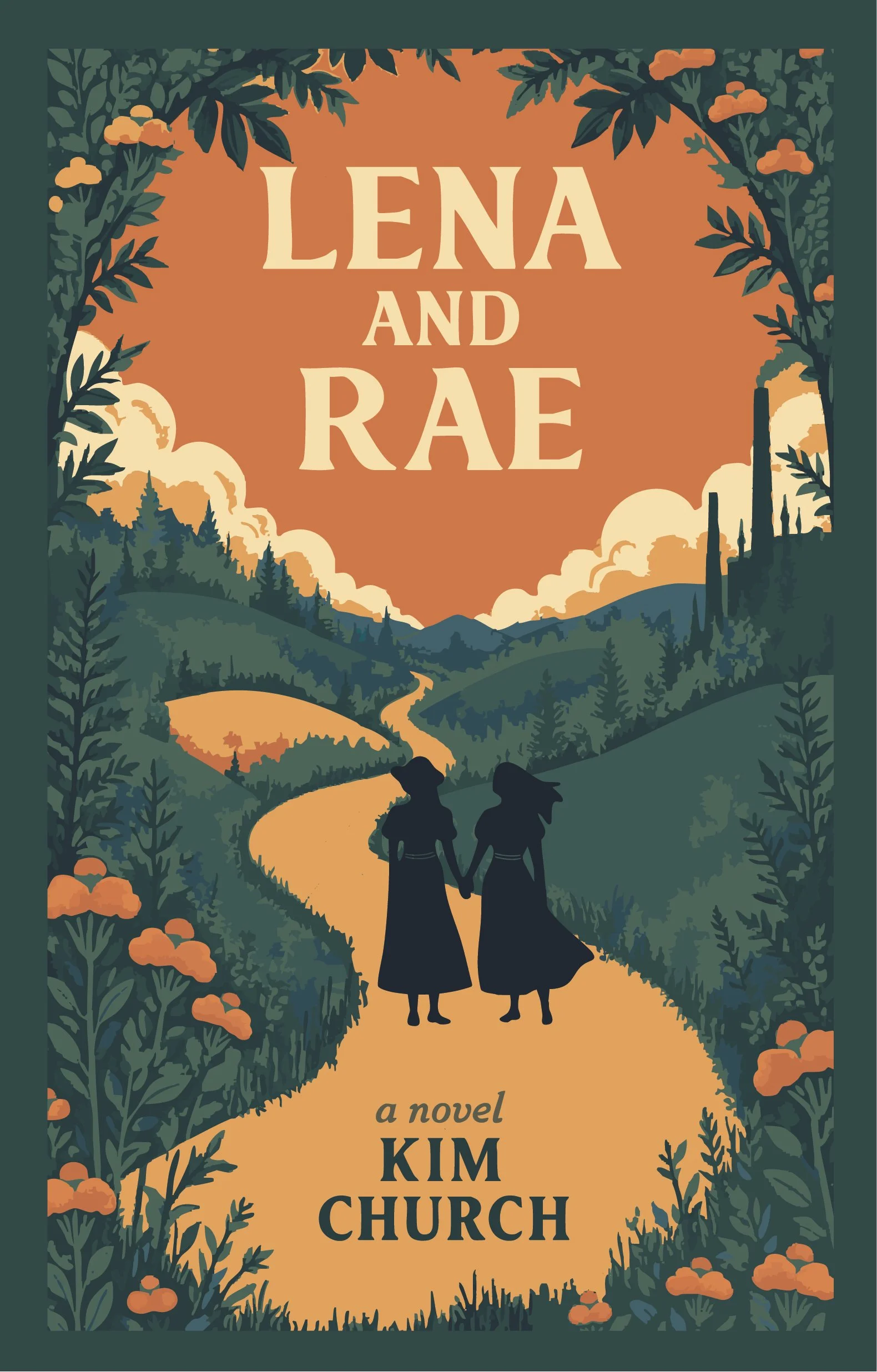
Lena and Rae
Born on the same day in neighboring farmhouses in Burke County, North Carolina, Lena and Rae are stark opposites and inseparable friends. Lena, the daughter of scratch farmers, learns early what it is to work. Rae, with her mother’s sweet voice and wild beauty, seems born to shine. After her mother’s death, Rae is taken in by Lena’s family and raised as Lena’s sister, bringing the two girls only a heartbeat apart.
When teenage Lena leaves the farm for work in the cotton mills, Rae follows, craving the independence and stability out of reach for so many women. But that stability is fleeting. When the mill owners impose a “stretch-out” — strict efficiency measures that push workers to their breaking point — strikes erupt, sparking a brutal class war and setting Lena and Rae on opposite sides of the picket line.
Part fictional retelling of the 1929 strike at Gastonia’s Loray Mill and the General Textile Strike of 1934, part intimate family saga, Lena and Rae weaves a deft, lyrical story of work and faith, love and struggle, and above all, the ties of sisterhood that endure after heartbreak.
Praise & Reviews
“Kim Church has written a powerful novel about the unionization of the mills in Gastonia, North Carolina. It is deeply felt and incredibly moving — a major work.”
—Lee Smith, New York Times bestselling author of The Last Girls and Silver Alert
“This beautiful, deeply affecting novel performs the twin miracles of making another time as vivid as our own and laying bare the shocking conditions and extraordinary courage of two women caught up in the deadly North Carolina textile strikes of the 1920s and 1930s. As indelible as their struggles are, Lena and Rae will stay with me for the quiet poetry of their everyday lives, rendered exquisitely by the profoundly talented Kim Church.”
—Ann Packer, author of Some Bright Nowhere
“In her extraordinary new novel, Kim Church not only chronicles the lives of two memorable women but also provides a compelling and often terrifying account of North Carolina textile mill communities during the early 1900s through the Depression. In the midst of hardship and survival, there is a refrain in the novel, “this is what love is”— a definition that shifts and changes with circumstance over the years, as does knowledge about loyalty and happiness and grief. The fluidity of time so beautifully captured is reason enough to read this novel, but that’s just the beginning. This is a work filled with rich rewards.”
—Jill McCorkle, author of Hieroglyphics and Old Crimes
“What a gorgeous, timely, and electrifying book this is. Kim Church’s lyricism will draw you in, and the story she tells will make your hair stand on end. The stark portrayal of working conditions in the mills feels heartbreakingly current, but it is the poetry of the language and the heroism of Lena and Rae that make this novel the masterpiece it is.”
—Abigail DeWitt, author of Philomène and News of Our Loved Ones
Background
My grandmother Church, who helped raise me, was a spinner in cotton mills. She rarely spoke of her job, but at her death in 1981, I opened the letter she’d written “for the family when I am gone” and learned something of the conditions in which she’d lived and worked as a young woman. Her letter mentioned the 1934 closing of the mill where she worked — the Erlanger Mill outside Lexington, North Carolina — but gave no details. I didn’t learn the reason for the closing until years later, in 1995, when PBS aired “The Uprising of ’34,” a documentary about a general textile strike involving some half a million workers — the largest in U.S. history, yet I had never heard of it. Our North Carolina history books contained no mention of the strike or the Southern labor movement that led to it. The film raised questions I wished I could have asked my grandmother. How did she work so hard for so long and so little and still bring up a family? When union organizers entered the mills, which side was she on?
This novel began as my attempt to imagine.
The General Textile Strike of 1934, a defining moment for labor in the South, was for many communities a painful episode best left forgotten. Few who lived through it wanted to talk about it, and it has largely been erased from history. To better understand its significance and to dramatize my story, I expanded my focus to the well-documented precursor strike at Gastonia’s Loray Mill in 1929.
Resources
Like a Family: The Making of a Southern Cotton Mill World, Jacquelyn Dowd Hall, James DeLoudis, Robert Korstad, Mary Purphy, Lu Ann Jones, and Christopher B. Daly
Strike, Mary Heaton Vorse
Proletarian Journey: New England, Gastonia, Moscow, Fred E. Beal
Gastonia 1929: The Story of the Loray Mill Strike, John A. Salmond
Gastonia Gallop: Cotton Mill Songs & Hillbilly Blues / Piedmont Textile Workers on Record, Gaston County, North Carolina, 1927-1931 (CD), Old Hat Records
Linthead Stomp: The Creation of Country Music in the Piedmont South, Patrick Huber
The Uprising of ’34 (video documentary), George C. Storey, Judith Helfland, and Susanne Rostock
Testing the New Deal: The General Textile Strike of 1934 in the American South, Janet Irons